
MASTER OF SCIENCE – RESTORATION
English-taught Curriculum within LM-4 Architecture – Restoration
A two-year, design-driven Master’s path for international students who want restoration studios, digital survey, HBIM-oriented thinking, structural rehabilitation, heritage law, and thesis work inside one of Europe’s richest built heritage contexts.
| 2 years – 120 ECTS Integrated two-year study plan in a Second-cycle Master’s degree |
B2 English Italian not required for the English curriculum |
EU-Recognized Architecture Degree Accredited according to European standards |
How to apply
- Link identifier #identifier__128077-1University procedure enrolment
- Link identifier #identifier__78522-2Call for application (COMING SOON)
- contact us to Link identifier #identifier__69313-3magistrale.architettura@uniroma3.it
Curriculum at a glance
Official structure: Master’s Degree (LM-4) in Architecture – Restoration, English curriculum: Master of Science – Restoration.
Year 1 Semester 1
Semester 2
|
Year 2 Semester 1
Semester 2
|
Link identifier #identifier__193712-4Download the plan
What students actually work on
- Integrated survey of historic buildings through direct, image-based, and range-based methods
- Virtual reconstruction and mathematical modeling of curves and surfaces
- Restoration design supported by planning tools and cultural heritage law
- Historical structures, crack interpretation, and rehabilitation strategies
- Portfolio and final thesis or original design project discussed before the committee
The official source materials also highlight site visits, strong applied learning, and practical tools connected to conservation and restoration workflows.
| Join us in | Write to
Link identifier #identifier__82757-6magistrale.architettura@uniroma3.it |
Apply
Link identifier #identifier__171971-7Call for application (COMING SOON) |
Read programme overview
Introduction
The Master of Science in Architecture Restoration has been designed to open our teaching programme to international students. We aim to give European and non-European students the chance to explore a key theme in the future of architecture for which Italy has specific expertise: architectural restoration.
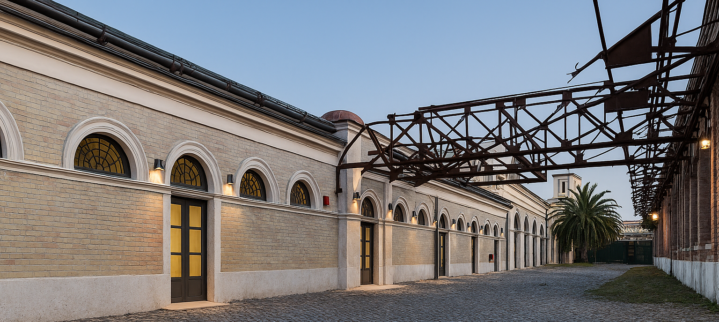
Italy has made a fundamental contribution to the academic discipline of restoration; it is the country where cultural debate has thrived and where design and operative activity have been carried out for centuries. Due to its millennia-long history, multi-layered urban structure, and high-quality architecture and environment, Rome is the best place to study it. The School of Architecture is located in the heart of the city, within the ancient Aurelian walls in the Testaccio district. The building itself is a prime example of urban regeneration. The former slaughterhouse has been renovated, successfully combining tradition and innovation, and has triggered the redevelopment of the entire neighbourhood. The place is now a vital and thriving arts hub.
Our school, although young, is founded on the solid theoretical approach of philological restoration. This is meant as the activity, based on technical and historical-critical knowledge, that, with rigorous methodology, leads to actions and interventions with the aim of re-appropriating the material and architectural meanings of pre-existing contexts. The English-taught curriculum of the Master of Science in Architecture Restoration runs parallel to the Italian one. It deals with design interventions on archaeological, architectural, monumental and modern heritage, developing a crucial and highly specialised aspect of the architect’s profession (monument restoration is, in fact, the only design activity exclusively reserved for architects).
The Master aims at introducing students to the various aspects of preservation through a multidisciplinary approach and a multifaceted perspective on cultural heritage, combining innovative, research-orientated teaching with traditional teaching methods. The course programme offers a synergy between different disciplines to provide students with the methods and tools needed to best interpret complex issues related to stratified historical contexts: restoration, architectural design, history of architecture, drawing, applied mathematics, mechanics and rehabilitation of historical structures, urban planning, cultural heritage law, construction technologies in the built heritage, and lighting for cultural heritage. The different subjects are mainly interlinked through design studios, organised sequentially, with one for each semester. Throughout the courses and workshops, students have the opportunity to participate in on-site inspections and field lessons, gaining hands-on experience with advanced intervention techniques and methodologies.
During the teaching programme, students deepen an understanding of the structuring elements of territories and the formative processes of urban fabrics, learning to decode their characters for informed design and adaptive reuse. Moreover, they study traditional building techniques and, suitably improved, apply them in restoration projects as an environmentally and economically sustainable solution. By doing so, we aim to achieve the highest standards of quality and excellence in education, while acknowledging the growing importance of emerging specialism in preserving cultural heritage. The degree course fosters teaching and research partnerships with associations, organisations and institutions that are responsible for protecting territory and cultural heritage.
Educational goals
Graduates will gain both theoretical knowledge and practical tools to tackle the preservation and adaptive reuse of historical architecture. The course fosters an understanding of traditional techniques and promotes sustainable, context-sensitive interventions. You will be trained to act as a critical professional able to shape policies and contribute to architectural conservation across diverse geographic and cultural landscapes.
Students will achieve the ability to deal with the different issues of historical heritage valorisation, with scientific and operative control skills. Complying with the requirements for the professional qualification of architects in Europe, this Master is primarily purposed at shaping a professional profile of a Heritage Restoration Expert, who will be able to actively take part in political agendas to push architecture forward while preserving our rich and many-sided built heritage.
Program outcome
- Students will achieve the ability to deal with the different issues of historical heritage valorisation, with scientific and operative control skills. As future architects, students will be able to interact with, understand and work constructively with the different features of the conservation and restoration field.
- The overall aim of the Master course is to equip the architects of the future with a specific knowledge of historical and technical culture, enabling them to design in harmony with the urban and environmental contexts of different historical-geographical areas.
- Complying with the requirements for the professional qualification of architects in Europe, this Master’s is primarily purposed at shaping a professional profile of a heritage restoration expert, who will be able to actively take part in political agendas to push architecture forward while preserving our rich and many-sided built heritage.
Program delivery
The teaching programme provides at the same time the possibility of applicative experimentation and design synthesis on the topic of restoring the quality of architectural heritage. It is articulated and worked out with a sequence of scientific-technical and historical-critical courses and design laboratories proposing a synergy between different disciplines to provide students with the methods and tools to better interpret the complex issues related to stratified historical architectural heritage.
About the School
Roma Tre University is a young university thought for young people. Founded in 1992, it has rapidly grown both in terms of students and the courses offered.
Admissions, Fees and Scholarships
Eligibility and selection timing Admission starts with an online application and includes evaluation of your CV and Transcript of Records.Non-EU citizens residing abroad, and Chinese citizens in the Marco Polo Programme, should follow Link identifier #identifier__75499-8Universitaly guidance; pre-enrolment for these candidates is completed exclusively on Link identifier #identifier__176267-9universitaly.it. The program has 60 places; for the 2026/2027 cycle, the call opens in April 2026 and classes start in late September 2026. |
Fees and scholarships The enrolment fee varies based on your income and on available concessions, and generally ranges from EUR 16 to EUR 2,000. To plan your funding strategy, explore opportunities for international students and scholarships: Link identifier #identifier__63707-11DiSCo Lazio – International Students and Link identifier #identifier__30193-12Roma Tre UNHCR UNICORE Scholarship Call. If you have questions on costs, concessions, or scholarship options, we look forward to hearing from you. |
Link identifier #identifier__184265-14Call for applications
| Why Roma Tre Link identifier #identifier__104977-15  |
| Campus and student experience Link identifier #identifier__102130-16  Link identifier #identifier__151834-17 Link identifier #identifier__151834-17
Link identifier #identifier__89608-18 |
